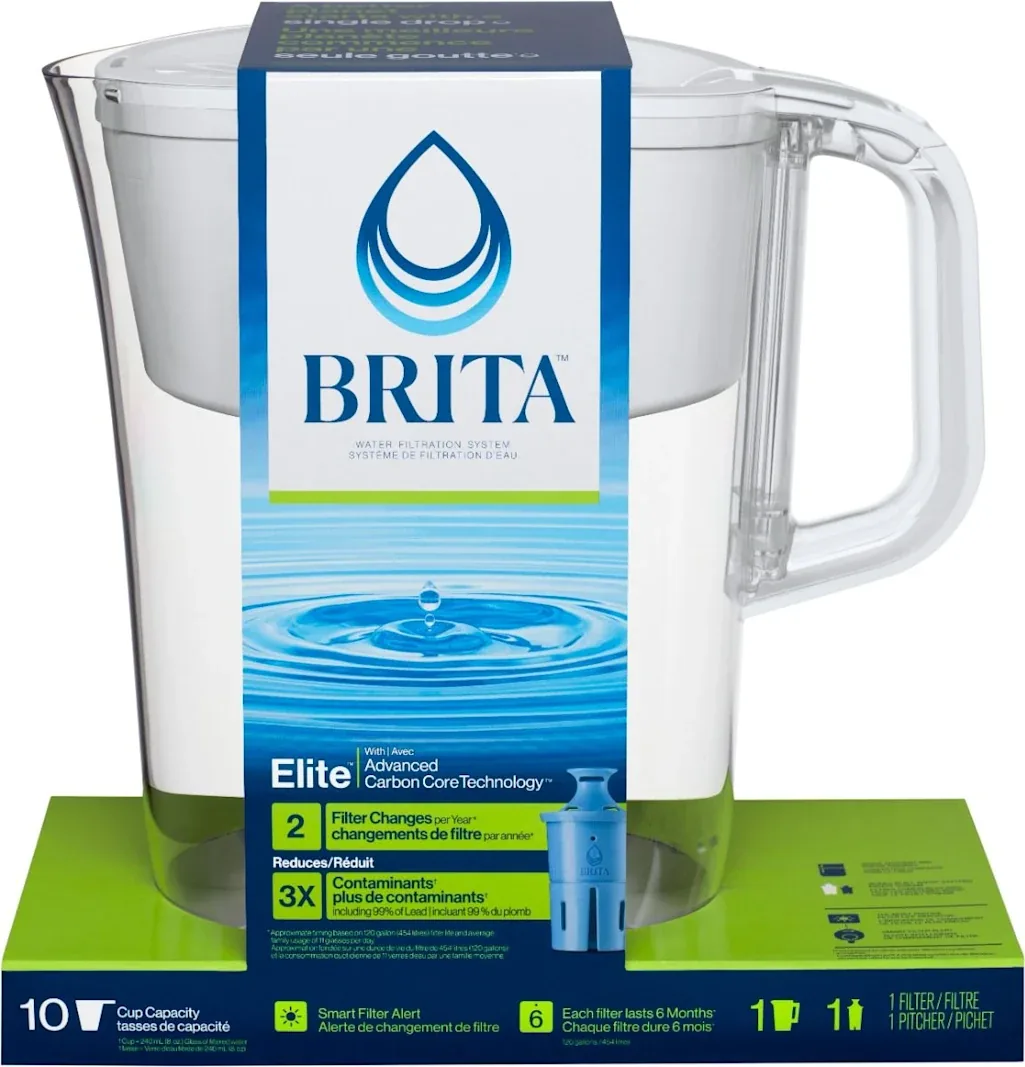
Device · Water Filter Pitchers
Brita
Brita Tahoe Pitcher
- Type
- Water Filter Pitcher
- Verified to fit
- 1 parts & consumables
- Maintenance
- 1-step schedule
- Capacity
- 10 cups
- Filter
- Brita Standard (Original)
As an Amazon Associate we earn from qualifying purchases made through this link.
- Verified to fit
- Live Amazon price
- Sourced guides
As an Amazon Associate we earn from qualifying purchases made through links on this page.
Brita Tahoe 10-Cup Pitcher: Filter Change & Care Plan
A step-by-step plan for keeping it working, written from verified fits and schedules.
Step 1
What you have
You own a Brita Tahoe Pitcher, a water filter pitcher from Brita's Pitchers & Dispensers model family. It's sold here as the Brita Tahoe 10-Cup Water Filter Pitcher (Standard Filter) — Brita Tahoe 10-Cup Water Filter Pitcher (Standard Filter).
What it does is simple: you pour cold tap water into the top reservoir, gravity pulls it through a replaceable filter cartridge, and filtered water collects in the lower pitcher body ready to pour. There's no power, no plumbing and no pump — the only moving part in the system is the filter you swap out on a schedule.
Key details on record
| Brand | Brita |
|---|---|
| Model | Tahoe Pitcher |
| Type | Water filter pitcher |
| Capacity | 10 cups |
| Filter used | Brita Standard (Original) |
| Filter life | 40 gallons, about every 2 months |
| Filter indicator | SmartLight |
| Material note | Made without BPA |
| Dimensions | 10.22 x 5.68 x 10.39 in (L x W x H) |
These specifications come from the manufacturer. The 10.22 x 5.68 x 10.39 in footprint is the figure to check against your fridge shelf or door bin before you commit to a spot for it.
It's used in the kitchen and dining area — typically stored in the refrigerator between fills, or kept on a counter or dining table for topping up glasses. The SmartLight indicator on the lid is the part that makes ongoing maintenance easy: it tracks filter use and tells you when a change is due, rather than leaving you guessing.
The whole ownership job for this pitcher comes down to two things: keeping a fresh Standard filter in it, and keeping the plastic parts clean by hand. Everything below is built around those two habits.
Step 2
What it needs
This is a low-consumable device. There's exactly one thing you have to buy again and again, plus a small amount of ordinary cleaning effort.
For filtration — the one consumable
- Brita Standard (Original) filter. This is the cartridge the Tahoe is specified to use. The verified genuine option that fits is the Brita Standard Pitcher Filter (3-Pack) — Brita Standard Pitcher Filter (3-Pack).
- Rated life: 40 gallons, about every 2 months.
For cleaning
- Mild detergent and warm water, by hand. The recorded maintenance guidance is to hand-wash the pitcher, lid and reservoir periodically with mild detergent. They are not dishwasher safe.
- Cold running tap water for flushing each new filter for 15 seconds before fitting.
- No specific branded cleaning product, descaler or cleaning tablet is recorded as verified for this pitcher, so nothing else is being recommended here. A soft cloth or non-abrasive sponge and your usual mild dish soap covers it.
For the device itself
- Replacement pitcher: if you need a second pitcher, or a replacement body, lid or reservoir, the unit itself is Brita Tahoe 10-Cup Water Filter Pitcher (Standard Filter).
- No other accessories — no separate lids, spouts, carafes or filter adapters — are recorded as verified to fit the Tahoe. If you want one, check Brita's own parts listings for your exact model rather than assuming a part from another pitcher will seat correctly.
Step 3
How to maintain it
There is one recorded maintenance task for this pitcher, and it's rated easy — no tools, no disassembly beyond lifting the lid.
Task: Replace the Standard filter
Interval: every 60 days — every 40 gallons, about every 2 months. Uses: Brita Standard Pitcher Filter (3-Pack).
- Check the SmartLight. A red indicator means the filter is due. Don't wait for taste to change — the light is the trigger.
- Empty the pitcher and remove the lid and the top reservoir.
- Lift out the old filter and discard it.
- Flush the new Standard filter under cold running water for 15 seconds before fitting it. This is a recorded step, not optional — it wets the media and rinses loose carbon dust.
- Seat the new filter in the reservoir, making sure it's pushed fully home so unfiltered water can't bypass it.
- Refit the reservoir and lid, then reset the SmartLight indicator so it starts counting the new filter's life.
- Fill and pour off the first couple of pitchers if you see carbon specks — see the troubleshooting note below.
Task: Hand-wash the pitcher, lid and reservoir
- Do this periodically — a natural moment is each time you change the filter, while everything is already apart.
- Remove the filter and set it aside.
- Wash the pitcher body, lid and reservoir with mild detergent and warm water by hand.
- Do not put any part in the dishwasher — these parts are not dishwasher safe.
- Rinse thoroughly, dry, reassemble and refit the filter.
Troubleshooting — the signs that mean something needs attention
| Symptom | Likely cause | What to do |
|---|---|---|
| Filter indicator shows red | The filter is due | Fit a new filter — run the replacement task above using Brita Standard Pitcher Filter (3-Pack) |
| Filters slowly | Sediment in the tap water, or aeration from filling at full stream | Check or adjust: don't open the faucet to a full stream, and don't aim the water straight onto the filter |
| Black specks in the water | Carbon particles from the filter — normal and harmless | Nothing to fix; this is common in the first fills after a filter change |
Two things worth drawing out of that table. First, slow filtering isn't automatically a dead filter — how you fill matters. A gentle, low-pressure stream directed at the side of the reservoir rather than down onto the filter reduces trapped air, which is one of the two recorded causes of slow flow. The other recorded cause is sediment in your tap water, which you can't change but which does mean a slowing pitcher late in a filter's life is behaving as expected.
Second, black specks are not a fault. They're loose carbon from the filter media, they're harmless, and they show up most often in the first fills. The 15-second cold-water flush before fitting is what keeps them to a minimum.
Anything outside these three recorded symptoms — cracked plastic, a lid that won't seat, a SmartLight that won't reset — isn't covered in the facts on record here. For those, follow Brita's own support guidance for the Tahoe rather than improvising a repair.
Step 4
What to use
Brita Standard Pitcher Filter (3-Pack) — genuine
Brita Standard Pitcher Filter (3-Pack)
What it's for: the one and only consumable this pitcher needs. The Tahoe is specified for the Brita Standard (Original) filter, and this is the genuine Brita item in a 3-pack. Each cartridge is rated for 40 gallons, about every 2 months, so a 3-pack covers roughly 6 months of normal use. Buying in a multi-pack is the practical move here: the SmartLight will go red whether or not you have a spare in the cupboard, and an unfiltered pitcher is the usual reason people fall off the schedule.
Remember the two handling rules that come with it: flush the new filter under cold water for 15 seconds before fitting, and expect harmless black carbon specks in the first fills.
Brita Tahoe 10-Cup Water Filter Pitcher (Standard Filter) — the device
Brita Tahoe 10-Cup Water Filter Pitcher (Standard Filter)
What it's for: the pitcher itself, listed here so you can identify the exact model you own, buy a second one for a bigger household, or replace the unit if the plastic body, lid or reservoir is damaged. It ships as a 10-cup pitcher with SmartLight indicator, made without BPA, and takes the Standard filter above.
On genuine vs compatible
Only the genuine Brita Standard filter is recorded as verified to fit the Tahoe. No third-party or compatible cartridge has been verified for this pitcher in the facts on record, so none is being recommended. If you do consider an aftermarket cartridge, confirm it's explicitly listed for Brita Standard/Original pitcher filters — a cartridge that doesn't seat fully lets unfiltered water bypass it, which defeats the point of the pitcher.
No cleaning product is on the verified list. Use mild detergent by hand, and keep every part out of the dishwasher.
Step 5
How often
Here is the whole schedule for this pitcher in one place.
| Task | Interval | Product |
|---|---|---|
| Replace the Standard filter | Every 60 days — every 40 gallons, about every 2 months | Brita Standard Pitcher Filter (3-Pack) |
| Flush new filter under cold water | 15 seconds, every time you fit a new filter | — |
| Hand-wash pitcher, lid and reservoir with mild detergent | Periodically (no fixed interval recorded — pairing it with each filter change works well) | — |
| Check the SmartLight indicator | Whenever you refill; red means the filter is due | — |
How that adds up over a year
- About 6 filters a year, changing roughly every 2 months.
- About 18 filters over 3 years.
- One 3-pack lasts about 6 months — so roughly two 3-packs a year, or six 3-packs across three years.
A simple buying rhythm
Order a 3-pack of Brita Standard Pitcher Filter (3-Pack) twice a year — for example at the start of the year and again mid-year. That gives you three cartridges on the shelf at a time, so a red SmartLight never means waiting for a delivery. Whenever you take the last filter out of a pack, that's your cue to reorder.
Note that 40 gallons and 60 days are two ways of describing the same filter life. A heavy-use household may hit 40 gallons before day 60; a light-use one may reach day 60 first. The SmartLight is there to reconcile the two — trust the indicator over the calendar.
Step 6
When to replace
The filter
The Standard filter is the part that genuinely wears out, and it has a clear end of life:
- On schedule: at 40 gallons or about every 2 months (every 60 days), whichever comes first.
- On the indicator: as soon as the SmartLight shows red. That's the recorded meaning — the filter is due — and the recorded fix is to fit a new one.
- On behaviour: if the pitcher is filtering slowly, first check how you're filling it. Don't run the faucet at full stream and don't aim it straight onto the filter, because aeration is one recorded cause. Sediment in your tap water is the other. If you've corrected your filling technique and it's still slow late in the cartridge's life, treat it as a filter due for replacement.
What is not a reason to replace a filter: black specks in the water. Those are carbon particles from the filter, recorded as normal and harmless, and most common in the first fills. Flush new filters for 15 seconds and they'll settle down on their own.
The pitcher, lid and reservoir
These are hand-wash-only plastic parts, made without BPA. There's no recorded wear interval for them. Replace them on condition rather than on a clock — cracks, crazing, a lid or reservoir that no longer seats properly, or a filter that won't sit fully home are all reasons to stop using the part, since a poor seal lets unfiltered water bypass the cartridge. Keeping them out of the dishwasher is the single best thing you can do for their working life, because that's the one handling restriction on record.
The device itself
There is no fixed lifespan recorded for the Brita Tahoe Pitcher, and no successor model is recorded either. No sourced figure exists in the facts for how many years the pitcher should last, so any number would be invention. Judge it on condition instead: as long as the body holds water without leaking, the reservoir and lid seat cleanly, the filter locks in place and the SmartLight still responds, a Tahoe that's kept on schedule and hand-washed is doing its job.
When it does reach the end — damage, a seal you can't restore, or you simply want a second pitcher for a bigger household — the same model is Brita Tahoe 10-Cup Water Filter Pitcher (Standard Filter), and it continues to take the same Standard filters, so any spare cartridges you already own carry straight over.
Step 7
Recommended products
A short shopping list, in the order you'll actually need things.
Brita Standard Pitcher Filter (3-Pack) — Brita Standard Pitcher Filter (3-Pack)
Genuine Brita. The one consumable the Tahoe needs. Each filter runs 40 gallons / about 2 months, so a 3-pack covers roughly 6 months. Buy this first, and keep a pack in the cupboard so a red SmartLight never leaves you pouring unfiltered water. Reorder about twice a year.Brita Tahoe 10-Cup Water Filter Pitcher (Standard Filter) — Brita Tahoe 10-Cup Water Filter Pitcher (Standard Filter)
The pitcher itself, for identifying your exact model, adding a second pitcher, or replacing a cracked or leaking unit. 10-cup capacity, SmartLight indicator, made without BPA, 10.22 x 5.68 x 10.39 in.
That's the complete verified list. No cleaning product, descaler or accessory is recorded as verified for this pitcher — mild detergent and warm water by hand, with nothing going in the dishwasher, is all the cleaning kit it needs.
If something's not right
Filters slowly
Likely cause: Sediment in the tap water, or aeration from filling at full stream
Fix: Check or Adjust — Don't open the faucet to a full stream or aim it straight onto the filter.
Source: manufacturerBlack specks in the water
Likely cause: Carbon particles from the filter — normal and harmless
Fix: Check or Adjust — Nothing to fix; common in the first fills.
Source: manufacturerFilter indicator shows red
Likely cause: The filter is due
Fix: Replace the Standard filter (maintenance task) — Fit a new filter.
Source: manufacturer
Maintenance schedule
- Uses: Brita Standard Pitcher Filter (3-Pack)
Replace the Standard filter
every 2 months · Easy
Every 40 gallons, about every 2 months. Flush a new Standard filter under cold water for 15 seconds before fitting. Hand-wash the pitcher, lid and reservoir periodically with mild detergent — they're not dishwasher safe. Source: https://www.brita.com/support/faq/pitchers/
What keeps the Tahoe Pitcher running
Brita Standard Pitcher Filter (3-Pack)
You might also need
Related devices & products
Similar & alternative options
Device · Water Filter Pitchers
Brita All Brita pitchers and dispensers (except Stream)- 1 to keep it running