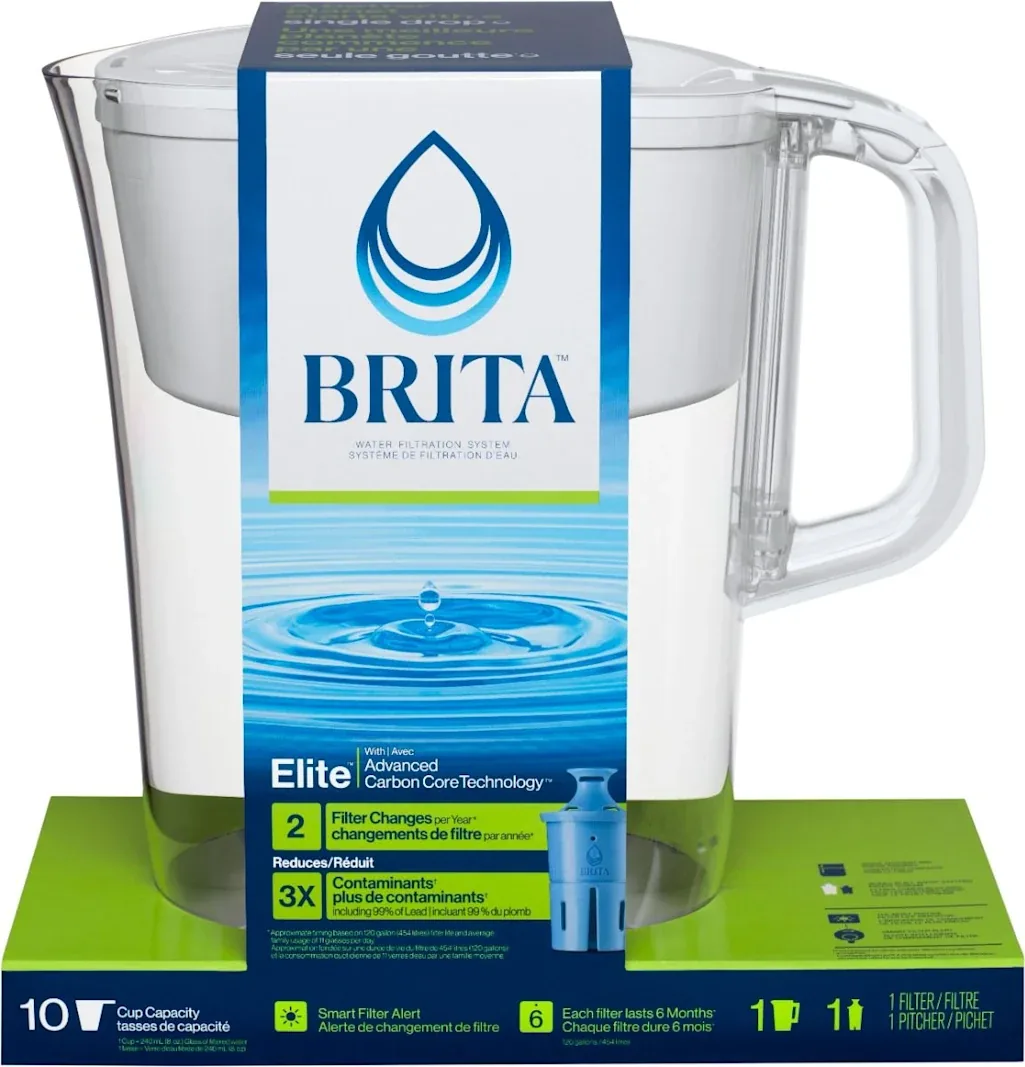
Brita Tahoe 10-Cup Water Filter Pitcher: Features Review
What the Brita Tahoe 10-Cup Pitcher Actually Is
The Brita Tahoe is a countertop and fridge-friendly water filter pitcher with a 10-cup capacity that uses the Brita Standard (also sold as Original) filter. Its job is narrow and well defined: you pour tap water into the reservoir at the top, gravity pulls it through a carbon filter cartridge, and filtered water collects in the lower chamber ready to pour. There is no electricity, no plumbing, no installation step, and no under-sink work. You fill it, you wait, you pour.
That simplicity is the whole pitch. A pitcher like this suits households that want better-tasting drinking water at the kitchen counter or on the dining table without committing to a faucet-mounted unit or a reverse osmosis system. The Tahoe adds one modern convenience to the classic formula — a SmartLight filter change indicator — and keeps a compact footprint so it can live in a fridge without eating an entire shelf.
If you have already decided the pitcher category is right for you, you can find the product here: Brita Tahoe 10-Cup Water Filter Pitcher (Standard Filter)
The Specifications That Matter
10-cup capacity
Ten cups is the mid-size tier of the pitcher world. In practice this is roughly enough to fill a few large drinking glasses or a couple of reusable bottles before the lower reservoir is drained and you need to refill the top. For one or two people who drink water steadily through the day, a 10-cup pitcher usually means refilling once or twice daily. For a family of four or a household that also uses filtered water for coffee, tea, and cooking, expect to refill it more often — or expect a second person to find it empty at an inconvenient moment. Capacity is the single biggest predictor of whether a pitcher feels convenient or annoying, so be honest about your household's daily consumption before buying.
Dimensions: 10.22 x 5.68 x 10.39 inches
That 5.68-inch width is the number worth noting. It is a deliberately narrow profile, which is what makes a pitcher of this capacity practical in a refrigerator rather than permanently parked on the counter. Measure the clear height and depth of the fridge shelf you intend to use, and measure the gap in front of it, before you buy. The research does not confirm that the Tahoe fits standard refrigerator door shelves, so if door storage is your plan specifically, treat that as unverified and check the manufacturer's own specifications or measure your door bin against the dimensions above.
Brita Standard (Original) filter, rated for 40 gallons
The Tahoe uses Brita's Standard filter, rated at 40 gallons or approximately two months of use — a 60-day replacement interval. That rating is a usage figure expressed as a time estimate, and the two do not always align. A single person who drinks a few glasses a day may not reach 40 gallons in 60 days; a busy household may hit it well before. The interval is a guideline anchored to the gallon rating, not a hard calendar rule.
Working from the 60-day interval, a typical year requires roughly six filters. Brita sells genuine replacements in single units and 3-packs, and the Brita Standard Pitcher Filter 3-Pack is verified to fit this pitcher. Two 3-packs will therefore cover a standard year of use at the recommended cadence. Whether larger multi-packs exist for this model is not confirmed in the available research.
One important limitation: the research does not confirm whether the Tahoe accepts Brita Elite (Longlast) filters or Standard filters only. If you were hoping to drop in a longer-life cartridge to reduce replacement frequency, verify that compatibility with Brita directly before assuming it.
SmartLight filter change indicator
The SmartLight indicator is the feature that most clearly separates this pitcher from the most basic models. Rather than relying on you to remember a date written on a sticky note, the indicator tracks usage and signals when the filter is due. A red indication is the prompt to change the filter. It is a small feature, but filter pitchers fail their owners in one predictable way — the filter gets left in far too long — and an on-device reminder meaningfully reduces that risk.
Made without BPA
The pitcher is made without BPA, which is now the baseline expectation for food and drink containers and will matter to buyers who specifically look for it. The exact plastic type and available color options are not confirmed in the research, so if material specifics or a particular colorway are decisive for you, confirm them on the listing before ordering.
What It Needs to Keep Running
Running costs and upkeep are refreshingly contained. The only consumable is the Standard filter, replaced on that roughly 60-day cycle, and filter replacement on this pitcher is rated as an easy maintenance task — no tools, no disassembly beyond lifting the lid and reservoir. Beyond that, the pitcher itself benefits from periodic cleaning of the reservoir and lid, as any container that holds drinking water does.
A few operational realities are worth knowing before you buy, because they are common enough that Brita owners routinely ask about them:
- New filter preparation. Whether a new Standard filter needs soaking or flushing before first use is a frequent question; follow the instructions packaged with the filter itself.
- Black specks. Loose carbon particles from the filter media are a well-known talking point among pitcher owners and a routine question for Brita users.
- Slow filtering. Filtration slowing down over time is another common report and is generally a sign that the cartridge is nearing the end of its useful life or needs attention.
These are documented as common buyer questions rather than defects specific to the Tahoe — they come with the gravity-filter category generally.
What Is Not Confirmed
Honest reviewing means flagging the gaps. The available research does not verify which specific contaminants the Brita Standard filter reduces, nor any NSF/ANSI certification claims. If you are buying to address a particular water quality concern — lead, chlorine byproducts, PFAS, or anything identified in a local water report — do not assume this filter addresses it. Check Brita's own published performance data for the Standard filter against your specific need. Also unverified: the pitcher's weight (empty or filled), whether it is dishwasher safe, warranty length and terms, filter recycling program availability, and country of manufacture.
Who It Suits
- Renters and small households who want filtered water with zero installation and zero commitment to the plumbing.
- One- and two-person homes where 10 cups covers a day or most of one.
- People who forget maintenance — the SmartLight indicator is genuinely useful here.
- Fridge-storage users who need a narrow profile and have measured their shelf against the 5.68-inch width.
- Buyers who value easy upkeep and a straightforward, widely available consumable in 1- and 3-packs.
Who Should Look Elsewhere
- Large or heavy-use households. Ten cups refilled constantly is a chore; a dispenser-style unit or a plumbed system will serve better.
- Anyone targeting a specific contaminant. Until you have verified the Standard filter's performance claims against your water report, a pitcher chosen on convenience alone is a gamble.
- Buyers who want long-life cartridges. Six filters a year is the Standard cadence, and Elite/Longlast compatibility is unconfirmed for this model.
- Anyone needing instant hot or chilled filtered water — this is a passive gravity pitcher, nothing more.
The Verdict on Features
The Tahoe is not trying to be clever. It is a 10-cup, BPA-free, narrow-bodied gravity pitcher built around Brita's most common and most widely stocked cartridge, with a filter-change indicator to keep you honest about the 60-day interval. The feature set is coherent: compact enough to store, large enough for a small household, and cheap to keep running in the sense that the only consumable is a mainstream filter sold in 1- and 3-packs. Its strengths are convenience and low friction. Its weaknesses are capacity ceilings for bigger families and the open question of exactly what the Standard filter removes — a question worth answering for yourself before you buy, not after.
As an Amazon Associate, Replenish earns from qualifying purchases made through links on this page.